KLAUS WEHNER

RARITIES IN PICTURES

The Picture of Discobulus installed
The Picture of Discobulus, installed.
In 2012, the year the Olympics took place in my neighbourhood in London, I was amongst a group of artists who were asked to contribute work to the exhibition 'A Question of Sport: LGBT artists and their relationship to inclusivity'. It was that year's 'Annual Pride Art Exhibition' curated by Michael Petry and hosted by the law firm Clifford Chance, where it was installed on the top floor of the high rise block they occupy on Canary Wharf - with partial views to the Olympic site and Greenwich.

navigator thumbnail to: The Picture of Discobulus
Click on the image to enlarge.
I worked with one of the most iconic athletic images of Western art history, the well-known 'Discobulus' or 'Disc Thrower'. Going back to a lost ancient Greek bronze it is known to us through Roman copies and from there through thousands of old and new, faithful or reinterpreted copies present in museums, collections, parks, homes and shops around the world.
I remade this icon of (art and) an idealised body, athletic discipline and human beauty as a montage that within itself consists of a multitude of male bodies.

My head was full at the time with the concept of ‘imageness’ that I researched and defined in my recently completed PhD thesis, where I also applied the concept to several literary examples, one of the these was Oscar Wilde's 'The Picture of Dorian Gray'.
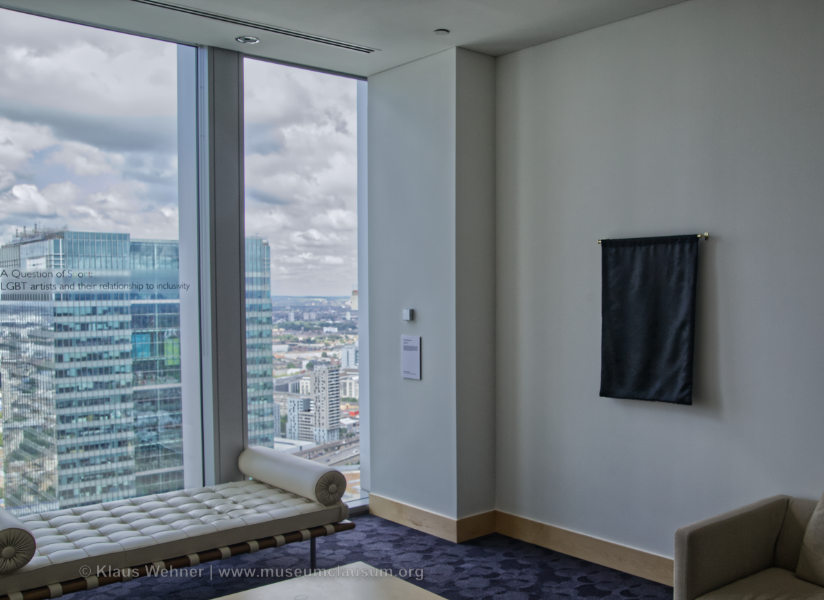
The Picture of Discobulus installed
The Picture of Discobulus, installed.
The Discobulus I made looks faceless and depersonalised, fragmented and somewhat ‘flayed’ - aiming to provide a pointer to the physicality of ‘body’ that is in contrast to the iconic imageness of ‘beauty’ and ‘athlete’.

The print is presented in an antique frame and installed being covered by a black curtain that the viewer has to lift up to see the image. This installation is initially a reference to the story of ‘The Picture of Dorian Gray’: That hidden ‘painting in the attic’ which is a magical inversion between artwork and model. Usually, the work of art preserves the image of a moment of beauty whilst the depicted is subject to time’s relentless progress.

At the same time, the installation in the context of this exhibition is a clear reference to the question of the visibility of LGBT athletes in modern sports: The hidden image, after all, has a well-visible presence as a black curtain on the wall.